
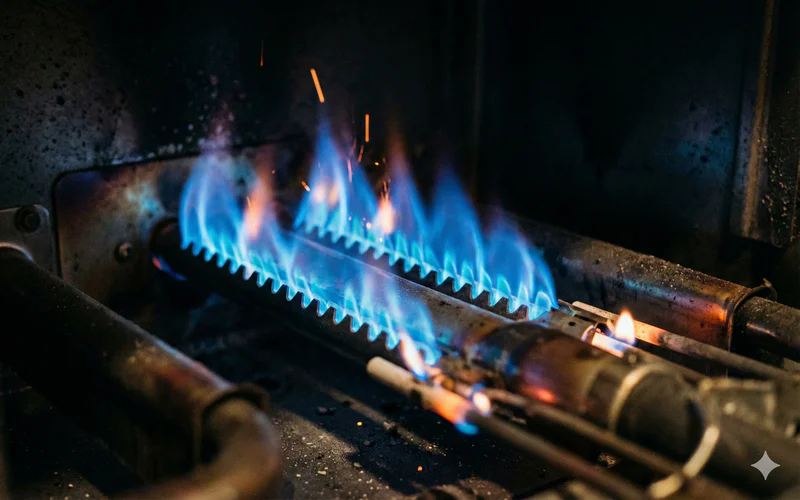
It is the middle of a freezing January night, and the familiar “whoosh” of your heating system brings a brief sense of relief. However, that relief vanishes five seconds later when the flame abruptly cuts out, leaving you in silence and creeping cold. If your furnace lights then shuts off, you are dealing with one of the most common yet frustrating HVAC issues. Whether you are considering buying furnaces to replace an aging unit or searching for a reputable Hvac center to perform an emergency repair, understanding the mechanics of this failure is the first step toward reclaiming your home’s warmth.
Before you begin tearing apart your cabinet, it is vital to identify your fuel source by asking is a furnace gas or electric. If you are still learning what is a gas furnace basics, this guide will provide the expert insight you need. This guide will dive deep into the technical reasons behind this “start-stop” behavior. We will explore the differences between various systems, the role of safety sensors, and the steps you can take to diagnose the problem before calling in a professional. With over 3,000 words of expert insight, this is the only resource you’ll need to understand why your furnace is struggling to stay lit.
Understanding the Sequence of Operation: How a Furnace “Lights”
To understand why a furnace shuts off immediately after lighting, we must first understand the “Order of Operations.” Modern gas furnaces are governed by an Integrated Furnace Control (IFC) board that follows a strict safety checklist. If any step fails, the system aborts the process to prevent a gas leak or fire.
1. The Call for Heat

It begins at the thermostat. When the ambient temperature drops below your set point, the thermostat closes a relay, sending a 24-volt signal to the furnace. In electrical terms, this is the “input” signal that starts the logic chain. If your furnace not kicking on for heat, this initial signal might be missing entirely.
2. The Inducer Motor and Pressure Switch

The furnace doesn’t just spark a flame immediately. First, a small fan called the draft inducer motor turns on. Its job is to clear the heat exchanger of any leftover combustion gases and ensure a steady draft. Once it reaches the correct speed, a pressure switch closes, telling the control board that it is safe to proceed. If you see 3 blinks on furnace, it often indicates a failure at this stage of the sequence.
3. Ignition and Gas Valve

Next, the igniter (either a spark or a hot surface igniter) activates. Once the igniter reaches the required temperature, the gas valve clicks open. Gas flows over the igniter, and—poof—the burners light. This is the moment where your furnace currently “works” before failing. If the furnace won’t light at all, the igniter may be cracked.
4. Flame Rectification (The Critical Moment)

This is where your problem likely lives. Within two to four seconds of the gas valve opening, the furnace must “prove” that a flame exists. It does this through a process called flame rectification. If the control board does not receive a signal that a flame is present, it will shut the gas valve off immediately to prevent unburned gas from filling your home. This is a common reason why a furnace quit running immediately after startup.
The Most Common Culprit: A Dirty Flame Sensor
If your furnace lights then shuts off within five seconds, the flame sensor is the prime suspect in 90% of cases.
What is a Flame Sensor?

The flame sensor is a thin, metallic rod that sits directly in the path of the burner flame. It is a “dumb” sensor in that it doesn’t have moving parts, but it performs a sophisticated electrical task. If you have a York unit, cleaning the york furnace flame sensor is a standard maintenance task required to keep the system reliable.
The Physics of Flame Ionization
When the burners light, the air around the flame becomes ionized. Ionized air can conduct a small amount of electricity. The furnace control board sends an alternating current (AC) to the flame sensor. The flame then “rectifies” this into a micro-ampere ($\mu A$) direct current (DC) that flows back to the furnace chassis. Using Ohm’s Law, we can understand the relationship between voltage ($V$), current ($I$), and resistance ($R$): $V = I \times R$. If the flame sensor is dirty, the resistance ($R$) increases due to carbon buildup (soot). This causes the current ($I$) to drop below the threshold required by the control board. When the current is too low, the board assumes there is no flame and shuts down the system, often displaying specific furnace error codes to alert the homeowner.
How to Clean a Flame Sensor

Cleaning a flame sensor is a common DIY task, but it must be done with precision:
- Power Down: Turn off the electrical switch to the furnace.
- Locate the Sensor: It is usually a single rod with one wire attached, located on the opposite side of the burner assembly from the igniter.
- Remove the Screw: Use a hex driver to remove the mounting screw.
- Gently Clean: Use a piece of light-grit sandpaper or a green scouring pad to rub the rod until the metal is shiny.
- Reinstall: Put the sensor back, reconnect the wire, and restore power.
Gas vs. Electric Furnaces: Why This Problem is Specific to Gas
As you explore the headers provided in this article, you’ll notice a significant amount of information regarding electric furnaces. It is important to clarify that an electric furnace cannot “light and then shut off” in the same way a gas furnace does, because an electric furnace has no flame. If you are asking what is an electric furnace, it is a unit that uses resistive heating elements rather than combustion to generate warmth.
How an Electric Furnace Generates Heat

Instead of burners and gas valves, an electric furnace uses high-resistance heating elements. When electricity flows through these coils, they glow red-hot due to electrical resistance. The power ($P$) produced by these elements can be calculated as: $P = I^2 \times R$.
Comparison of Failure Modes
If you are asking is a furnace electric or gas while troubleshooting, remember that electric units fail due to sequencers or blown elements. If you see the furnace yellow flame, you undeniably have a gas unit with a dangerous combustion issue that requires immediate attention. While electric furnaces are often safer and have a longer lifespan—homeowners often ask can a furnace last 50 years regarding these models—they are more expensive to operate. When evaluating an 80 vs 90 furnace, you are comparing gas efficiency levels, as electric units are always 100% efficient at the point of use.
Airflow and Safety: Short Cycling vs. Immediate Shutdown
If your furnace stays lit for more than 30 seconds but shuts off before the house is warm, you aren’t dealing with a flame sensor. You are dealing with a furnace keeps short cycling issue, often caused by overheating.
The Role of the High-Limit Switch

The high-limit switch is the “brain’s” emergency brake. It monitors the temperature of the heat exchanger. If the air inside the furnace gets too hot, the limit switch trips, cutting power to the gas valve to prevent the heat exchanger from cracking. If your furnace kicks on then shuts off after a few minutes, overheating is the likely cause.
Why Airflow is the Lifeblood of Your HVAC

The most common reason for a furnace keeps cycling on and off is restricted airflow. This brings us to the importance of changing your filter. A clogged filter acts like a wall, making the blower motor struggle to pull air through, which means the heat exchanger isn’t being cooled down. Similarly, if you have a furnace under house crawlspace installation, dust buildup can be even more aggressive.
Ignition Failures: Beyond the Flame Sensor
Sometimes the furnace “lights” but only in one burner, or the flame is unstable.
Dirty Burners and Clogged Orifices
If the gas cannot flow smoothly through the burner ports, the flame may be “lazy” or fail to reach the flame sensor. This is common in basements that are dusty or have high humidity. A professional at an HVAC center will use a wire brush or compressed air to clear these ports.
Faulty Gas Valve
While rare, the gas valve solenoid can fail. It might open just enough to light the flame but fail to stay open under the full pressure of the gas line. If the gas pressure is not consistent, the flame will flicker and fail the rectification test.
Thermostat Issues: Is the “Brain” Confused?

Before tearing your furnace apart, look at the wall. Low batteries or power-sharing issues can cause the furnace to cycle off just as it starts. If you have a furnace zone system, a stuck furnace zone damper might also confuse the system’s pressure sensors by creating unbalanced airflow.
The Bigger Picture: California’s Push for Electrification and Future Trends
The push for electrification is a massive trend in 2026. Many jurisdictions are forcing a shift toward electric furnaces and heat pumps. Removing gas eliminates the risk of carbon monoxide ($CO$) and gas explosions. While a gas furnace is at best 98% efficient, a heat pump can have a Coefficient of Performance ($COP$) of 3.0 or higher. If your gas furnace is constantly failing, it may be time to look into switching to a high-efficiency electric air handler paired with a heat pump, which may require a Furnace Zone Valve Replacement for hybrid configurations.
Cost of Repair vs. Buying Furnaces
When your furnace fails, the big question is always: Fix it or replace it? If the repair is more than 50% of the cost of a new furnace, replacement is usually the smarter financial move. Newer units are the quietest gas furnace options available today, providing whisper-quiet comfort compared to older, roaring models.
Maintenance and Prevention: Avoiding the Cold
A professional tune-up includes measuring sensor micro-amps and checking for microscopic cracks in the heat exchanger. You should also determine your furnace year by serial number to see if your unit is nearing its 15-20 year reliable limit.
Why does my gas furnace light for 5 seconds and then stop?
This is almost certainly a dirty flame sensor. The furnace lights the gas but cannot “prove” the flame is there, so it shuts the gas off as a safety precaution.
Can I bypass a flame sensor?
Absolutely not. Bypassing safety sensors is extremely dangerous. If the gas valve stays open without a flame, your house will fill with explosive natural gas.
Is an electric furnace cheaper than gas?
In terms of upfront installation, yes. However, in terms of monthly utility bills, electricity is generally more expensive than natural gas in most regions.
Does a gas furnace need electricity?
Yes. It needs electricity for the control board, the inducer motor, and the blower fan. If the power goes out, your gas furnace will not work.
What is the lifespan of a modern furnace?
Most gas furnaces last 15 to 20 years, while electric furnaces can last 20 to 30 years because they don’t deal with the corrosive byproducts of fire.
How do I know if my heat exchanger is cracked?
Signs include a flickering yellow flame, soot inside the furnace, and your carbon monoxide detector going off. A cracked heat exchanger requires immediate furnace replacement. Check York Furnace Error Codes or Keeprite Furnace Error Codes for specific safety alerts.
Identifying Your Unit: Carrier vs. Bryant vs. Lennox
Each brand has its own way of telling you what is wrong. Carrier and Bryant often use status lights on the control board. If the system hits a furnace 1 hour lockout, it means it has tried to light several times and failed.
Why Your “New” Furnace Might Be Failing
If you’ve recently invested in buying furnaces and your brand-new unit is failing, it is likely an installation issue. Incorrect polarity or poor grounding can prevent the flame rectification process from completing, causing the system to shut down after 5 seconds.
Final Thoughts: Don’t Settle for a Cold Home
A furnace that lights then shuts off is a machine crying for help. In most cases, it is a simple matter of cleaning or a new sensor. By following this guide, you can walk into your local HVAC center with the knowledge of a pro. Treat your furnace with the maintenance it deserves, and it will keep your family safe and warm for years to come.