
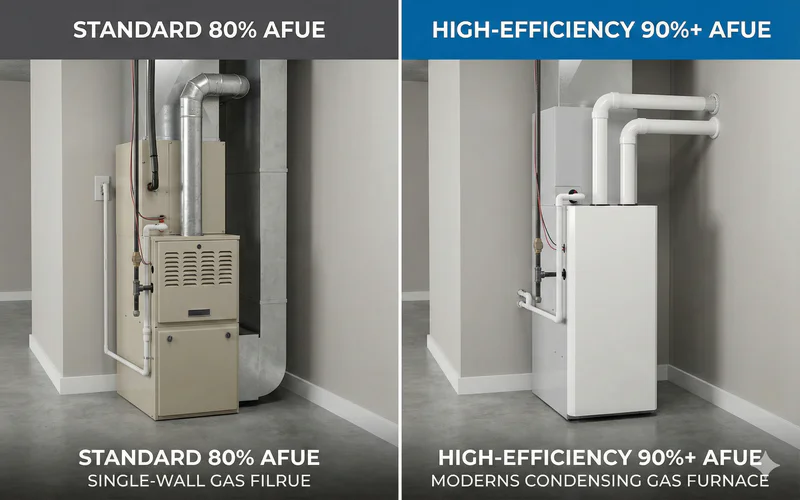
As we move through the winter of 2026, the decisions homeowners make regarding their climate control systems have never been more significant. Whether you are currently in the process of buying furnaces for a new construction project or visiting a local Hvac center to replace a unit that has finally reached the end of its lifespan, you are likely facing the “80 vs 90 furnace” dilemma. This choice represents a fork in the road between traditional, rugged reliability and modern, high-tech efficiency. Choosing the right AFUE rating is a decision that involves thermodynamics, regional economics, and the physical architecture of your home. In this master guide, we will break down every technical, financial, and operational difference between 80% and 90% furnaces to ensure you make the best investment for the next two decades.
Understanding AFUE: What Does “80% vs 90% Furnace” Mean?

To understand the difference between these two systems, we must first master the metric used to judge them: AFUE, or Annual Fuel Utilization Efficiency. In the simplest possible terms, AFUE is the measure of a furnace’s seasonal efficiency. It tells you exactly how much of the energy in the fuel is being converted into heat for your living space and how much is being lost to the atmosphere through the exhaust. If you are still asking “is a furnace gas or electric?”, knowing your AFUE is a key way to identify your system’s technology level.
When we say a furnace is 80% efficient, it means that for every 100 units of natural gas or propane consumed, 80 units are delivered as heat to your home, and 20 units are wasted as hot exhaust gases escaping through your chimney. An 80% furnace is often referred to as a “Standard Efficiency” or “Non-Condensing” furnace. In contrast, a 90% furnace (which often goes as high as 98.5% in 2026 models) is a “High Efficiency” or “Condensing” furnace. If you are researching “what is a gas furnace” technology, the condensing process is the biggest innovation in the last 30 years.
The math of AFUE is vital for your budget. If you spend $1,000 a year on heating with an 80% furnace, $200 of that money is literally going up the roof. With a 96% furnace, only $40 is wasted. Over the 20-year lifespan of a furnace, that $160 annual difference compounds into thousands of dollars in savings, but as we will see, the upfront costs and installation requirements often complicate this simple calculation.
Differences Between 80% Furnaces and 90% Furnaces: The Internal Mechanics
The physical “guts” of these two machines are remarkably different. While they both burn gas to create heat, the way they handle that heat is where the magic (and the engineering complexity) happens. If your furnace not kicking on for heat, the complexity of these high-efficiency parts might be the reason.
The Standard 80% Design: Simple and Hot
An 80% furnace uses a single Primary Heat Exchanger. Natural gas is ignited in the burners, and the flames pass through these metal tubes. A blower fan pushes house air over the outside of these tubes, picking up the heat. Because an 80% furnace is designed to be “non-condensing,” the exhaust gases must remain hot—usually above $150^\circ\text{C}$—to ensure they rise naturally out of the chimney. If the exhaust gets too cool, it won’t “draft” correctly, and it can stall in the vent, leading to carbon monoxide risks.
The 90% Design: The Secondary Heat Exchanger Revolution
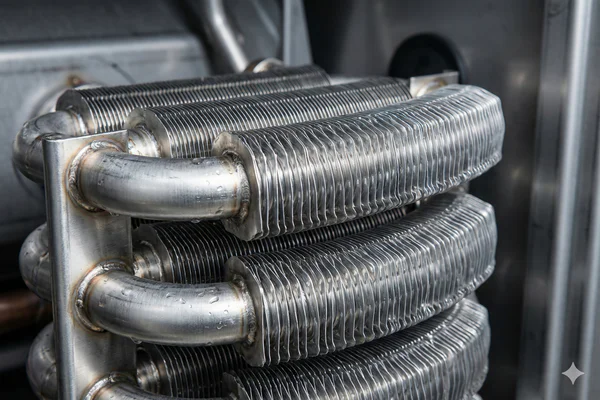
A 90% or higher furnace introduces a Secondary Heat Exchanger. After the exhaust gases leave the primary exchanger, instead of being sent up the chimney, they are routed through a second set of coils. In this secondary stage, even more heat is extracted. This process is so efficient that the exhaust gases cool down significantly. At this lower temperature, the water vapor in the exhaust reaches its “dew point” and condenses into liquid water. This phase change from gas to liquid releases latent heat, which the furnace captures and sends into your home. This is why 90%+ furnaces are called “condensing furnaces.”
Installation Requirements for 80% vs. 90% Furnaces: The Venting Challenge
One of the most significant differences between an 80% and a 90% furnace is how they “breathe.” This is often the deciding factor for homeowners in older properties.
80% Furnaces: Metal Flues and Chimneys
Because the exhaust from an 80% furnace is hot and buoyant, it requires a vertical metal flue, often called a B-vent. These flues typically run through the center of the house and out through the roof. If you are replacing an old 80% unit with a new 80% unit, the installation is usually straightforward because the existing chimney can be reused.
90% Furnaces: PVC Piping and Side-Wall Venting
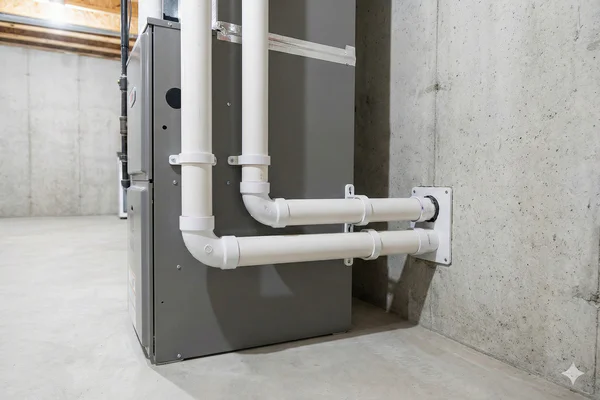
A 90%+ furnace cannot use a traditional chimney. The exhaust is too cool to rise naturally and is highly acidic. High-efficiency furnaces use PVC piping instead. Because the exhaust is cool, it can be pushed horizontally through a side wall of the house using a dedicated inducer fan. If your furnace won’t light, it’s often because this inducer fan or its associated pressure switch has failed. If your diagnostic board shows 3 blinks on furnace, it frequently points to a venting or pressure issue in these 90% models.
The Condensate Management Factor: Dealing with the “Sweat”
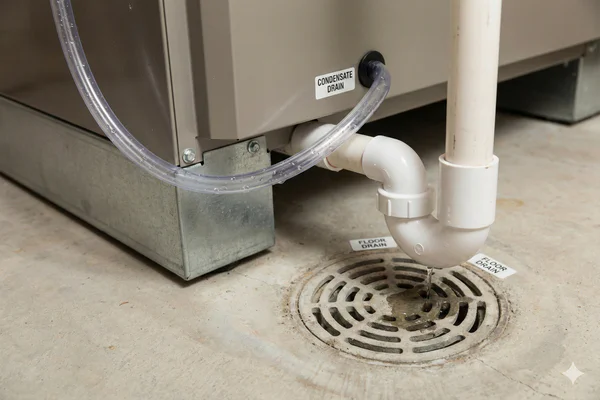
As we mentioned, 90%+ furnaces produce liquid water. In a typical winter day in a cold climate, a high-efficiency furnace can produce several gallons of water. This water must be managed. If you have a furnace under house crawlspace installation, managing this drainage is even more critical to prevent wood rot.
Drainage Requirements
An 80% furnace is “dry.” There is no water to deal with. A 90% furnace, however, needs a drain. Most installations involve a PVC drain line that runs to a nearby floor drain. If the drain clogs, your furnace quit running to prevent water from backing up into the cabinet. This can even trigger a furnace 1 hour lockout where the system refuses to restart until the blockage is cleared.
Cost Comparison: 80% Furnace vs. 90% Furnace in 2026
Price is almost always the primary driver for homeowners. When you visit an Hvac center, the quote for a high-efficiency unit will always be higher.
Upfront Equipment Costs
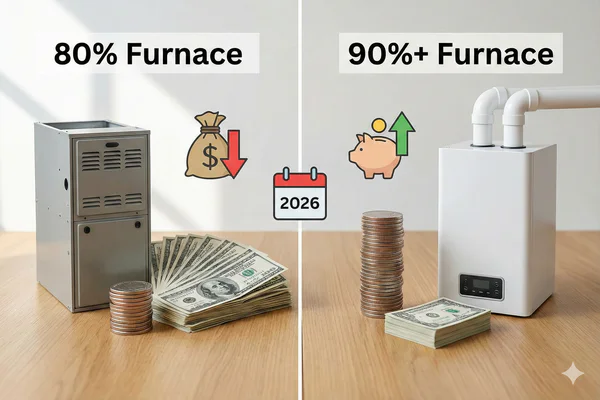
The equipment itself for a 90% furnace is more expensive because of the secondary heat exchanger (usually made of high-grade stainless steel). On average, the unit itself will cost $800 to $1,500 more than an 80% model of the same brand. If you are looking for the quietest gas furnace, these 90%+ models usually feature more insulation and quieter motors, which adds to the price.
Installation Labor Costs
The labor for a 90% unit is higher because of the venting and drainage requirements. Running PVC pipes through a rim joist and sealing the exterior penetrations takes time. In some cases, the installation labor for a 90% unit can be double that of an 80% unit if the house’s architecture is complex.
Long-Term Savings and ROI
Despite the higher upfront cost, the 90% furnace is often the cheaper option over its lifetime. In a cold climate, a 95% furnace will typically pay for its “price premium” in 5 to 7 years. When you check your furnace year by serial number and realize your unit is near 20 years old, an upgrade to 90%+ is the logical choice to maximize future savings.
How to Decide Which Furnace Is Right for Your Home
Choosing between 80 and 90 is not a “one size fits all” decision. It requires an analysis of your lifestyle and your home’s infrastructure.
1. Your Geographic Climate

Climate is the biggest factor. If you live in a region where the furnace runs for 2,000 hours a year, the 90%+ unit is almost mandatory. However, if you live in a mild climate, the 80% unit makes more financial sense.
2. Length of Residency

Are you planning to live in this home for more than 10 years? If so, buy the 90%+. If you are planning to sell the home in 24 months, an 80% unit is a valid choice. Many homeowners ask “can a furnace last 50 years?”, but realistically, most 90% units are built for a 15-20 year high-efficiency lifecycle.
3. Home Architecture and Venting Constraints

In some older urban homes, the furnace is buried in a center-closet where running PVC to an outside wall is physically impossible. In these cases, sticking with an 80% furnace is often the only practical solution.
The Performance and Comfort Results: It’s Not Just About Fuel
When we talk about 80% vs 90%, we are usually talking about efficiency. But we also need to talk about Comfort. High-efficiency furnaces are almost always paired with more advanced performance features like a furnace zone system.
Single-Stage vs. Two-Stage vs. Modulating
- Single-Stage (Typical of 80%): The furnace is either 100% on or 100% off. This often leads to a situation where the furnace kicks on then shuts off too quickly, known as short cycling.
- Two-Stage (Typical of 90%+): The furnace can run at 60% capacity on mild days and 100% on extreme days.
- Modulating (High-End 90%+): The furnace can adjust its flame in 1% increments. If your furnace keeps short cycling on a modulating model, it usually points to a sensor fault rather than a sizing issue.
Variable-Speed Blower Motors (ECM)

Modern 90%+ furnaces almost always feature Variable-Speed ECM Motors. Unlike the standard motors in many 80% units, these can ramp up and down slowly. This keeps the air moving at a low, quiet speed. If your furnace keeps cycling on and off loudly, it is likely a single-stage motor issue.
Maintenance and Lifespan: Which is More Durable?
When you are buying furnaces, you want something that will last.
80% Durability
The 80% furnace is the “Jeep” of the HVAC world. It is built for rugged simplicity. Because the exhaust stays hot, the heat exchanger stays dry. There is very little corrosion.
90% Maintenance Needs
The 90% furnace is the “Luxury Sedan.” It’s more comfortable but needs more service. The secondary heat exchanger is constantly “wet.” If you notice a furnace yellow flame, it is a dangerous sign of incomplete combustion that must be addressed immediately by a pro who can check your york furnace flame sensor or equivalent part.
Frequently Asked Questions
What’s the real difference between an 80% and a 90% efficient furnace?
The primary difference is that a 90% furnace has a secondary heat exchanger that extracts heat from exhaust gases by condensing water vapor.
Why does my high-efficiency furnace lights then shuts off immediately?
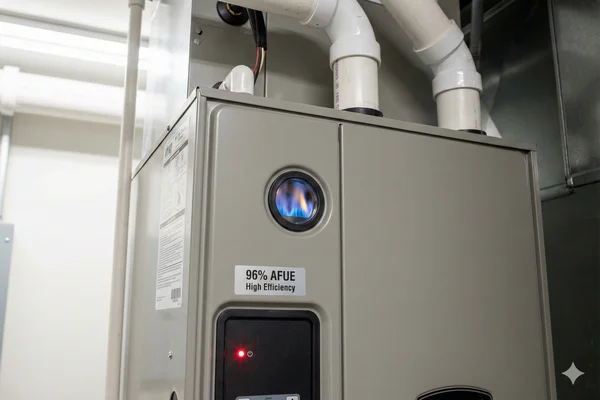
This is usually caused by a dirty flame sensor. High-efficiency units have sensitive electronics that will shut the gas valve if the flame isn’t “proven” within seconds.
Is an 80% furnace the same as an electric unit?
No. If you are asking “is a furnace electric or gas?”, both the 80% and 90% are gas models. If you want to know “what is an electric furnace“, it is a unit that uses resistive coils instead of burners.
Can I use oil in these furnaces?
No. Gas furnaces require natural gas or propane. If you use oil, you need to understand what is furnace oil maintenance, which is entirely different from gas condensing technology.
Do I need to replace my furnace zone damper?
If you are moving from an 80% to a 90% unit, your ductwork pressure will change. You may need a Furnace Zone Valve Replacement or a recalibration of your dampers to handle the new airflow.
How do I read furnace error codes?

Most modern 90% units have a LED light on the board that blinks. You can look up specific guides like Keeprite Furnace Error Codes or York Furnace Error Codes to diagnose why your heat stopped.
The Bottom Line: Making Your Final Choice
The decision between an 80% and a 90% furnace comes down to a balance of your current budget and your future goals. Choose an 80% furnace if you are on a strict upfront budget or have impossible venting constraints. Choose a 90% or 95%+ furnace if you live in a cold climate and want to take advantage of government tax credits.
In 2026, the trend is clearly moving toward high-efficiency condensing units. Efficiency is how well the furnace uses gas, but Sizing is what determines whether your house actually gets warm. By weighing these factors—climate, installation complexity, and long-term savings—you can choose the system that will keep your family safe and warm for the next twenty winters.